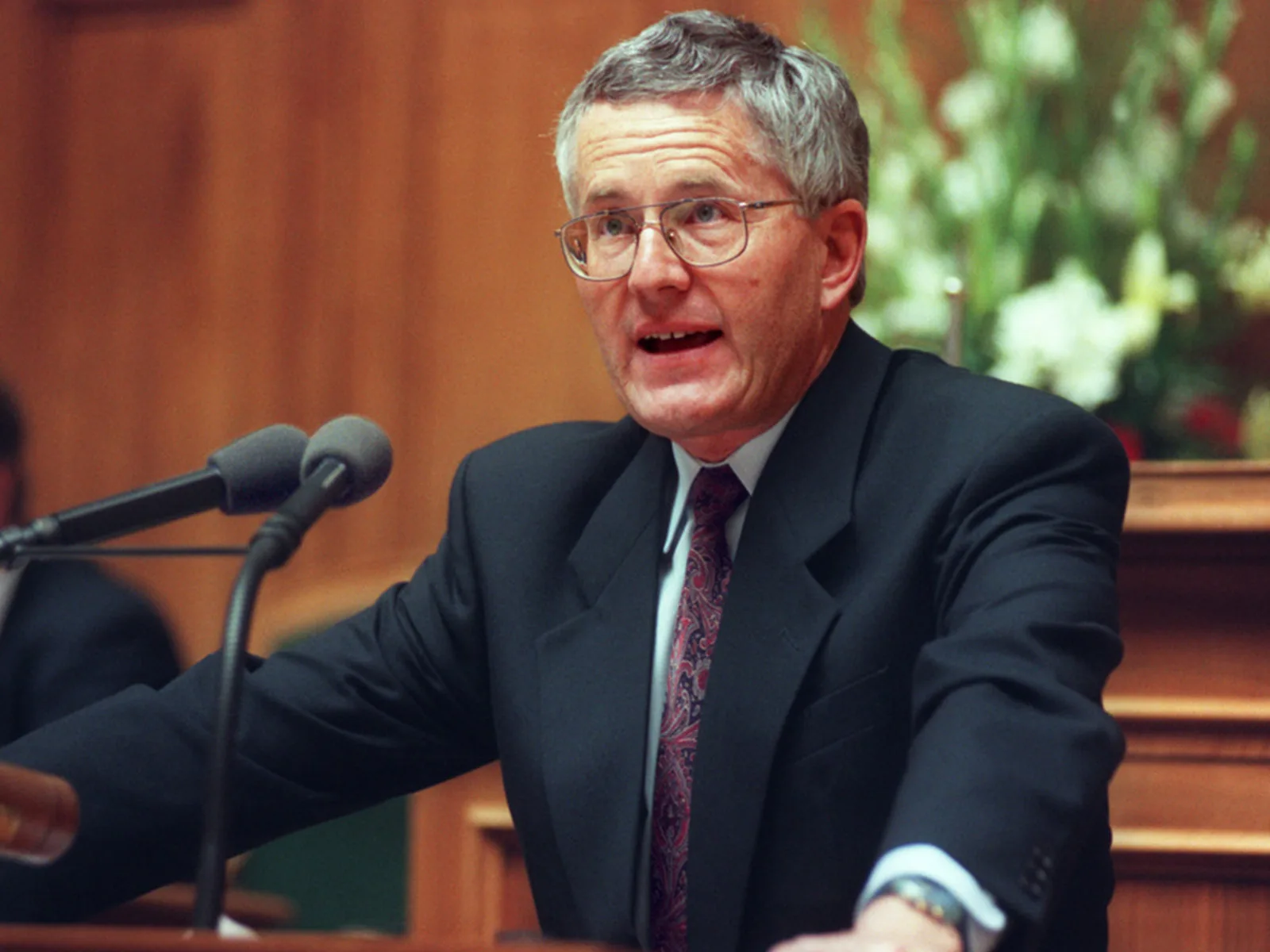
On 7 May 1995, the then Swiss President Kaspar Villiger addressed the United Federal Assembly. He commemorated VE Day 1945 and apologised for Switzerland’s refugee policy during the Second World War.
On 7 May 1995, the then Swiss President Kaspar Villiger addressed the United Federal Assembly. He commemorated VE Day 1945 and apologised for Switzerland’s refugee policy during the Second World War. Keystone / STR

Remembering the Second World War – but how?

In 1995, Switzerland commemorated the end of the war in 1945, and the Federal Council issued an official apology for the country’s refugee policy during that period. At the time, nobody could have anticipated that Switzerland’s role in the Second World War would feature so much in Swiss foreign policy for years to come.

Thomas Bürgisser

Thomas Bürgisser

Thomas Bürgisser is a historian at the Diplomatic Documents of Switzerland (Dodis) research centre.
The gesture was unplanned. In the autumn of 1994, the Federal Council had rejected a parliamentary request on how the Swiss national government intended to commemorate the 50th anniversary of the end of the Second World War. The generation in active service had already been thanked for their services as part of the ‘Diamantfeiern’ (diamond jubilee) in 1989 on the occasion of the 50th anniversary of mobilisation. The peace settlement of 1945 was of course a momentous event in world history. But Switzerland had not been involved in it. “Unlike the victors of the Second World War, the Federal Council will not be holding a national event in 1995 to mark the 50th anniversary of the end of the war.” And the government stayed true to that by not organising a ceremony.
Commemorating the end of the war in May 1945. SRF
Nonetheless, the Federal Council was to find that it couldn’t just sidestep the issue. “Every week, a new idea emerges about how we could mark this anniversary,” lamented economic affairs minister Jean-Pascal Delamuraz at the Federal Council meeting of 3 May 1995. Originally, only a speech by Swiss President Kaspar Villiger to be broadcast on radio and television was planned to mark Europe Day. As a concession to the growing public need for a fitting celebration of the anniversary, the Federal Council decided in March 1995 that all its members would participate in an inter-denominational commemoration service initiated by the Christian-Jewish Working Group in Switzerland at the Berner Münster cathedral on the evening of Sunday 7 May. Shortly afterwards, the National Council and Council of States also decided to call an extraordinary meeting of Parliament for 7 May. Naturally, the Federal Council couldn’t ignore this event, and so Villiger was to deliver his speech at the ceremony in the Federal Palace.
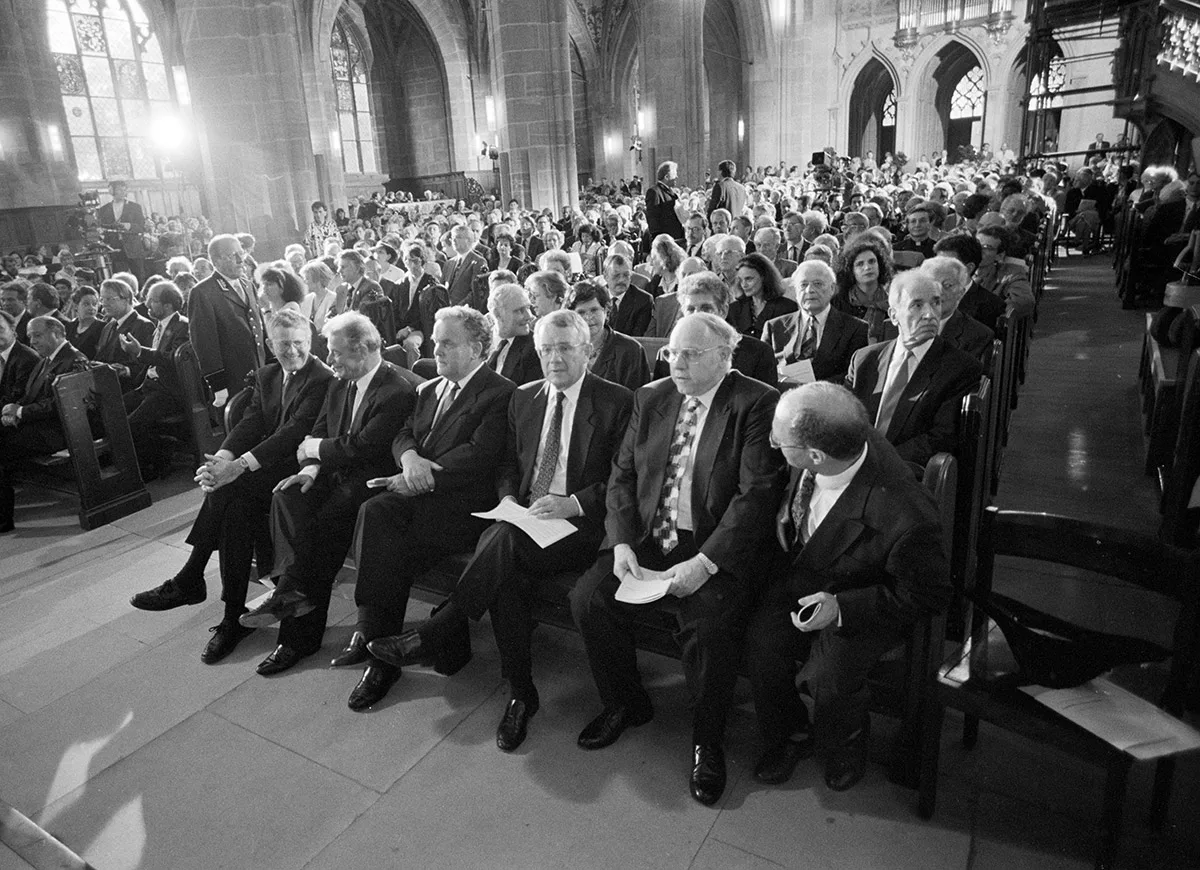
On 7 May 1995, all members of the Federal Council took part in a commemoration service to mark the 50th anniversary of the end of the Second World War.
On 7 May 1995, all members of the Federal Council took part in a commemoration service to mark the 50th anniversary of the end of the Second World War. Swiss National Museum
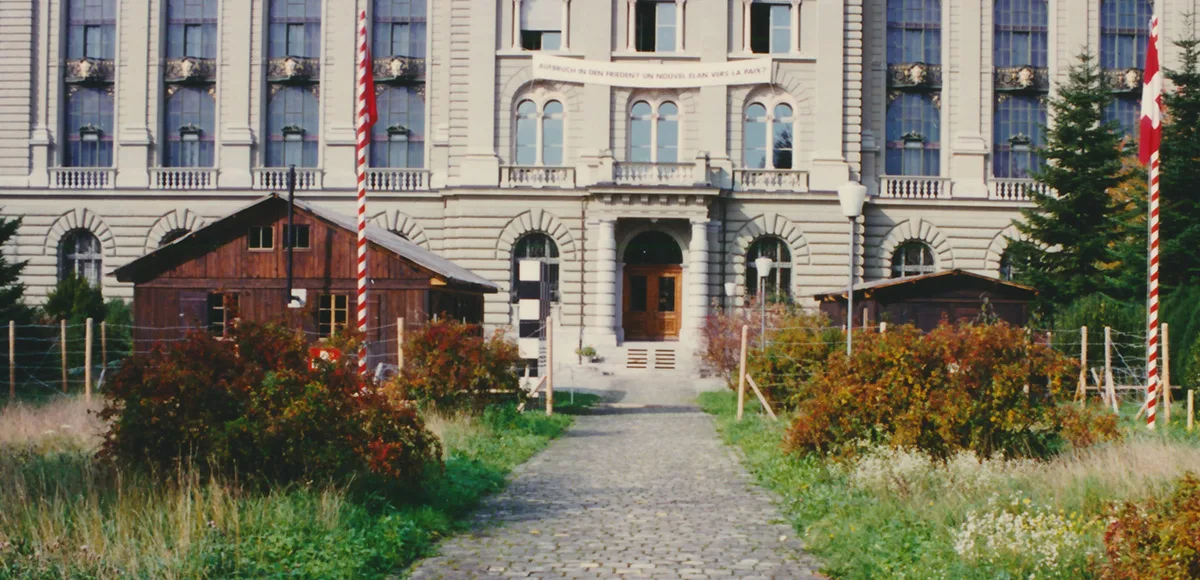
But that was not all: the Swiss Federal Archives – which were part of the Federal Department of Home Affairs, headed by Federal Councillor Ruth Dreifuss – were planning an on-site exhibition for that autumn entitled ‘Aufbruch in den Frieden’ (The journey towards peace). The exhibition was to feature a historical accompanying publication, various exhibits and photographs from the war, and a replica wire entanglement and field barracks in front of the main entrance. Meanwhile, SP National Councillor from Zurich Andreas Gross was calling for a monument to be built to remember the Jewish refugees who were turned away at the border, while FDP National Councillor from Geneva Peter Tschopp requested a special loan of 50 million Swiss francs for the peacebuilding activities of the International Committee of the Red Cross. As the special parliamentary session drew closer, it started to become a bone of contention. For example, the Social Democratic Group protested against the fact that only members of centre-right parties would get a chance to speak in the National Council chamber on 7 May. The media eagerly seized on the polemic. For example, the commemoration of the 50th anniversary of the end of the war was covered on Swiss television on the political and current affairs show ‘Rundschau’ and on the discussion programme ‘Arena’ in the first week of May. The history of the Second World War ended up being a hot topic 30 years ago.
In 1995 the Swiss Federal Archives staged the exhibition ‘Aufbruch in den Frieden?’ It also redesigned its main entrance for the occasion.
In 1995 the Swiss Federal Archives staged the exhibition ‘Aufbruch in den Frieden?’ It also redesigned its main entrance for the occasion. Dodis
At the Federal Council meeting of 3 May, Swiss President Kaspar Villiger finally presented some extracts from his speech. “After careful consideration and lengthy debate, the Swiss president concludes that the Federal Council would be well advised to apologise for its past mistakes towards persecuted Jews,” so read the meeting minutes. Villiger read out the key statements: “Fear of Germany, worry about foreign infiltration through mass immigration, and concern about political impetus for antisemitism – which also existed in Switzerland – sometimes outweighed our asylum tradition, our humanitarian ideals. Difficult trade-offs were resolved in an excessively risk-averse manner, to the detriment of our humanity,” said Villiger. “We made the wrong decision at the time because we took too narrow a view of the national interest. This is something that the Federal Council deeply regrets, while recognising that such a failure is ultimately inexcusable.”
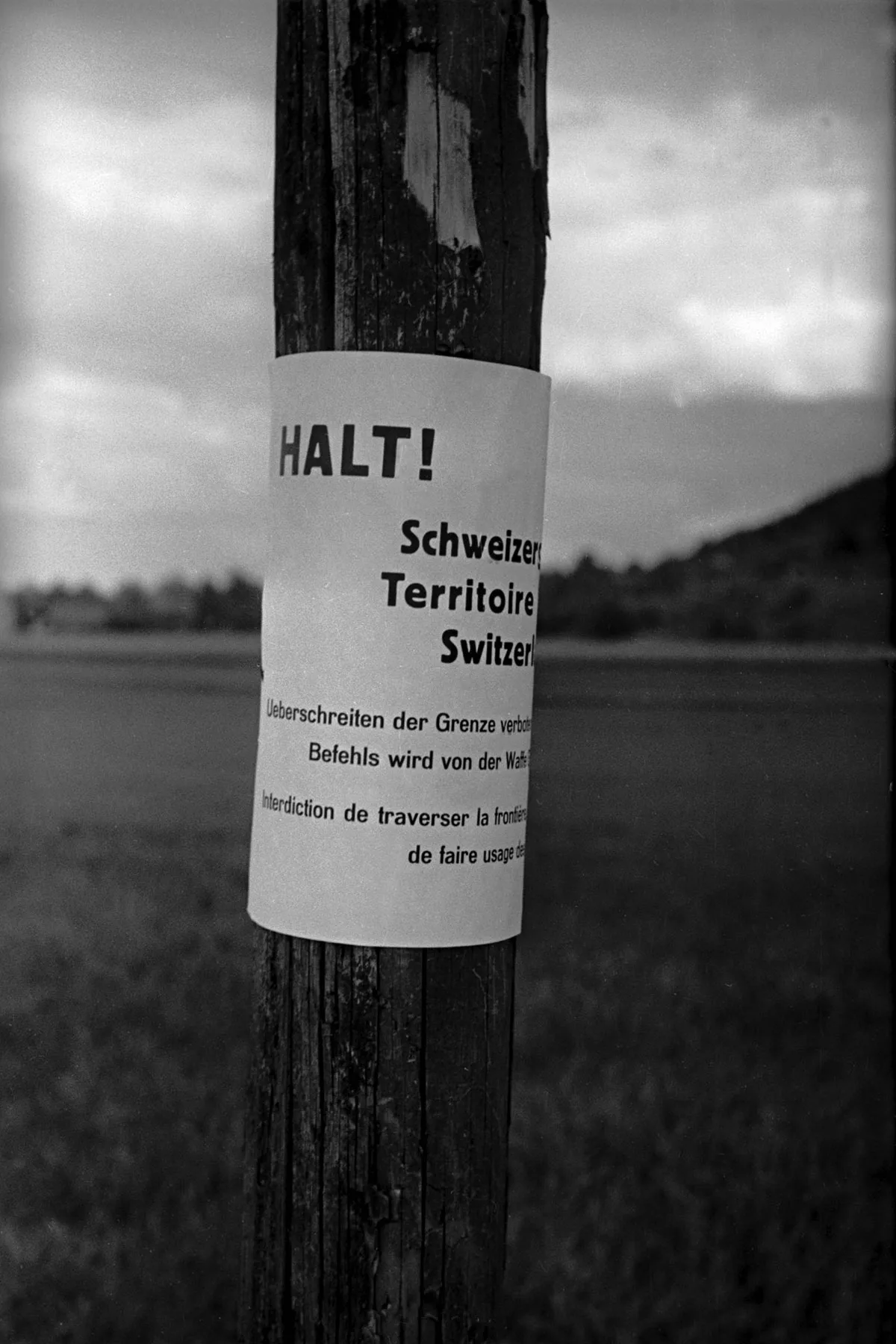
The Swiss border was for a long time almost impassable for refugees. The authorities only relaxed their approach from 1944.
The Swiss border was for a long time almost impassable for refugees. The authorities only relaxed their approach from 1944. Dukas / RDB
In the discussion, the head of the Federal Department of Foreign Affairs, Federal Councillor Flavio Cotti, emphasised the need to mention the positive aspects of Switzerland’s policy from that time. Arnold Koller, head of the Federal Department of Justice and Police, countered that as a lawyer he had some trouble with the term apologise, but was persuaded that the word should be interpreted as a vernacular term. The reactions of the two Social Democratic members of the Federal Council were also interesting. Otto Stich spoke of a difficult past and emphasised that the apology didn’t mean that “in future we can accept all refugees”. For Federal Councillor Ruth Dreifuss, on the other hand, the trouble was that the apology was not directed at anyone. Nonetheless, she was grateful to Villiger for the gesture, saying that it was good for the country.
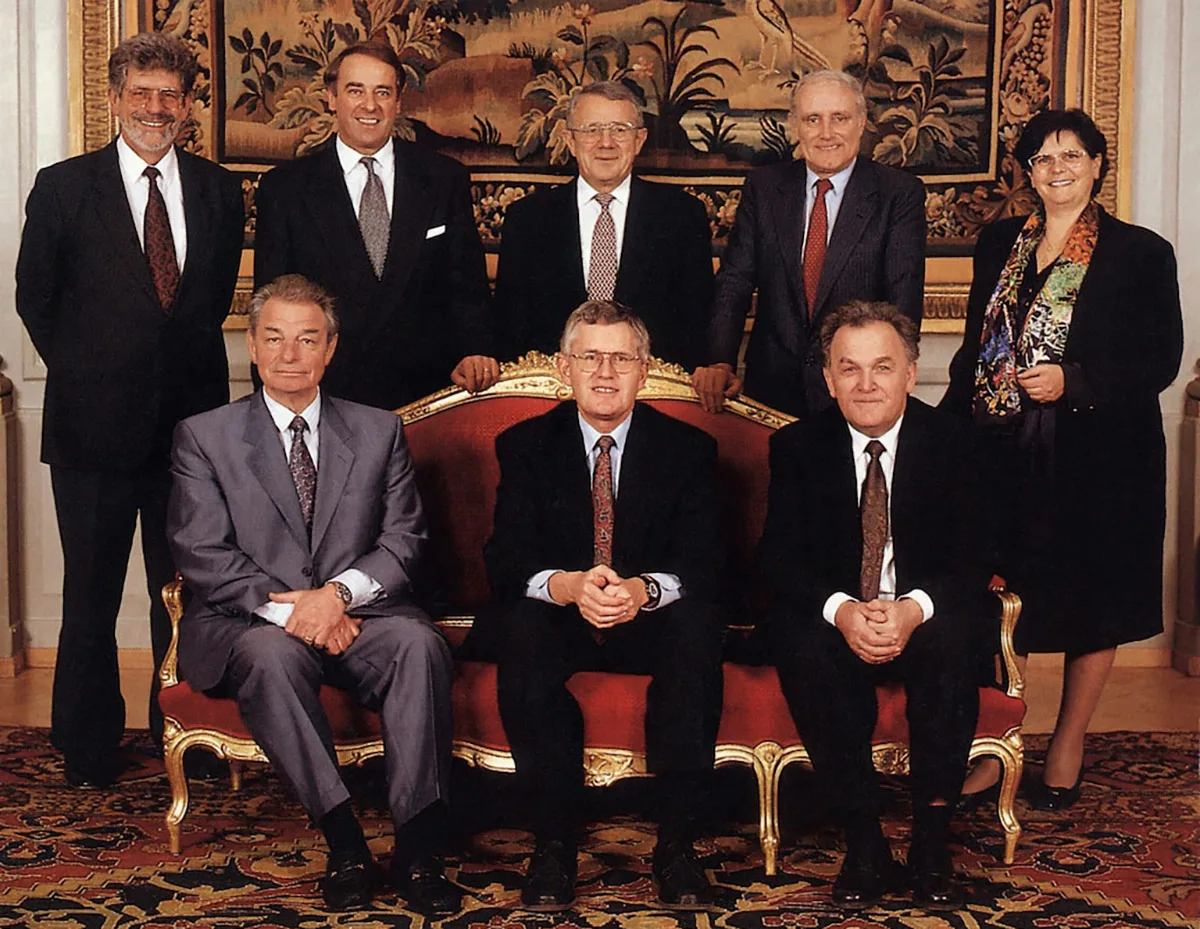
The commemoration of the end of the Second World War sparked a number of debates within the Federal Council.
The commemoration of the end of the Second World War sparked a number of debates within the Federal Council. Wikimedia / Swiss Federal Chancellery
Various members of the Federal Council spoke out publicly in 1995 about Switzerland’s role in the Second World War. On 3 April, at a commemoration ceremony for Carl Lutz, the Swiss Vice-Consul in Budapest who had saved tens of thousands of Jews from deportation to concentration camps by issuing passports and letters of protection in 1944, Federal Councillor Flavio Cotti praised Lutz as a “silent but great hero.” He went on to say that Lutz’s courage compels politicians today to “set the bar of our ethical responsibility sufficiently high, for example through generous humanitarian aid, and by helping the defenceless in Switzerland and all over the world, through a resolute human rights policy that goes beyond declamatory statements.”
Federal Councillor Otto Stich also took to the floor on 7 May with a welcome address at the evening ceremony at the Münster. Summing up the position of the Swiss authorities during the Second World War, the finance minister said: “Less compliance and more moral courage would have been in order.” Finally, Federal Councillor Ruth Dreifuss spoke out at a remembrance event organised by the Swiss Social Democratic Party in Thun on 8 May. “If we fail to take a critical and self-critical look at the past, we risk repeating the same mistakes,” she said. Dreifuss added that the legacy of the victims to future generations is an obligation to “protect indivisible human dignity and human rights from their enemies, wherever we are.”
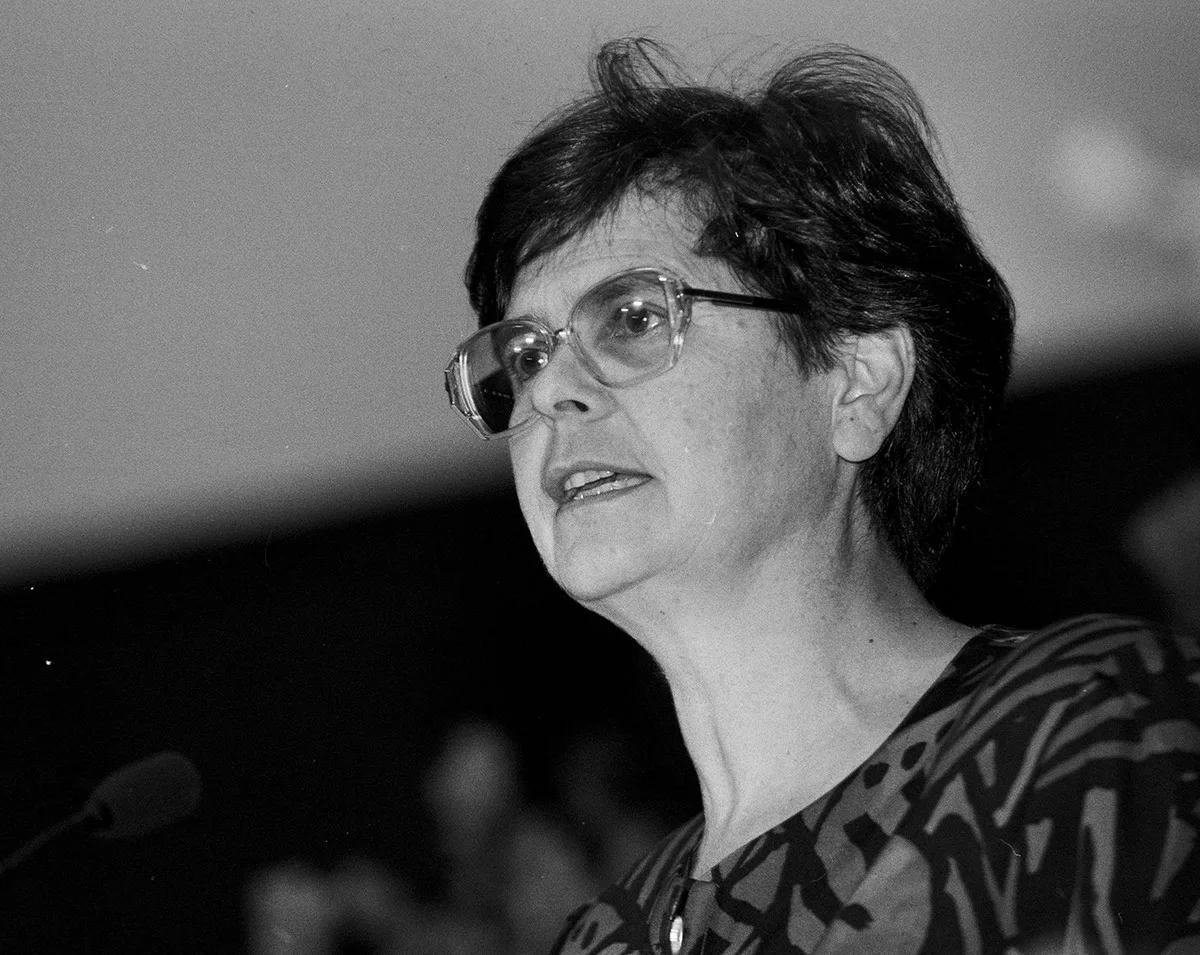
After some initial reluctance, more and more members of the Federal Council spoke out about the end of the war in 1945. Including Ruth Dreifuss, pictured here in Thun in 1993.
After some initial reluctance, more and more members of the Federal Council spoke out about the end of the war in 1945. Including Ruth Dreifuss, pictured here in Thun in 1993. Swiss National Museum / ASL
Swiss President Kaspar Villiger did more than just deliver an historic apology on 7 May, he also addressed the lessons that can be learned from history. “The fact that we were spared from the war imposes a special moral obligation on us” he declared “to help ensure that what happened in the context of the Second World War can never happen again.” If this imperative could be interpreted as a desire to compensate in future for the restrictive refugee policy of that time, an opportunity soon arose for Switzerland to demonstrate its tolerance and generosity in accepting refugees. That summer, in the middle of the summer recess, the members of the Federal Council were called to a telephone conference in the wake of the Serbian attacks against UN safe areas in eastern Bosnia, and the reconquering of Krajina by Croatia, which forced hundreds of thousands of people to flee. Specifically, the meeting concerned a request from the Office of the UN High Commissioner for Refugees (UNHCR) to accommodate a still-to-be-determined quota of additional people displaced by war in the former Yugoslavia.

Overtaken by events

At a rough estimate, between 5,000 and 50,000 people were to be distributed among different host countries. The setting of a provisional figure for Switzerland descended into haggling, which came across as anything but generous and tolerant. Asylum minister Arnold Koller proposed a maximum of 1,000, but finance minister Otto Stich warned that would be a lot for Switzerland. If Switzerland were to rush ahead too quickly, there were fears that it could have a boomerang effect. Even Federal Councillor Adolf Ogi urged caution: “What we really must avoid is providing far-right groups in Switzerland with political ammunition.” He said that a figure of 500 was potentially realistic. Foreign minister Flavio Cotti, on the other hand, considered a figure in the region of 1,000 to be the lower limit, and Ruth Dreifuss described this as the absolute minimum and that the figure must not fall below this. Meanwhile, Federal Councillor Jean-Pascal Delamuraz was unable to contribute to the debate as he was dialling in on a German mobile phone with poor network coverage, and the connection was lost. In the end, the remaining Federal Council members agreed on the wording proposed by the Swiss president to the UNHCR to “guarantee entry to an appropriate number of people.” Following the confidential debate, the Federal Council members were very clear about what had to be avoided in the public communication. As the minutes read, “under no circumstances must an impression be created that Switzerland is petty and narrow minded.”
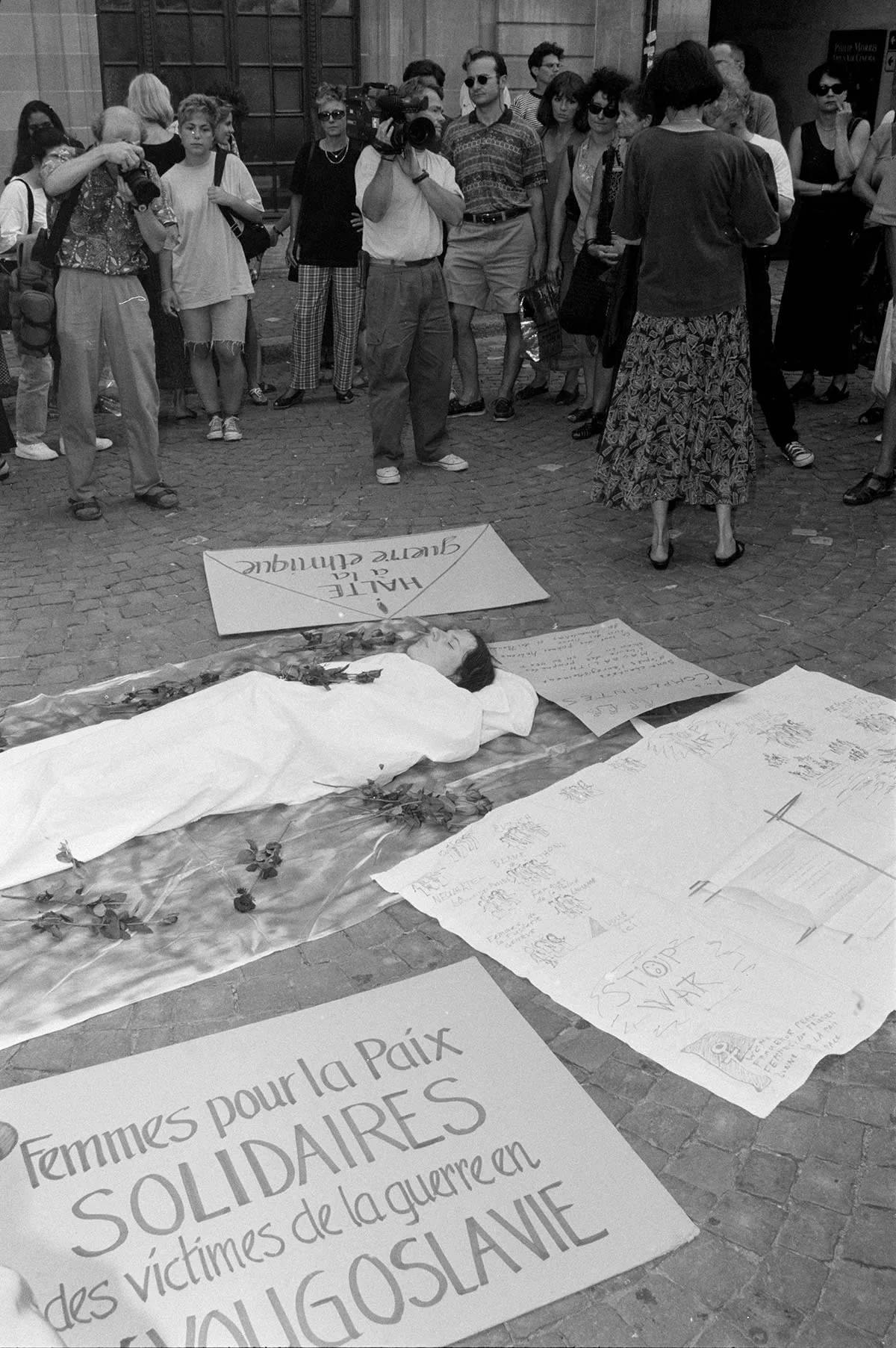
In early August 1995, a demonstration was held in Lausanne against the war in Bosnia.
In early August 1995, a demonstration was held in Lausanne against the war in Bosnia. Swiss National Museum/ASL
Villiger’s speech aimed to smooth over the cracks in remembrance policy that existed in Swiss society and that had come to light in the run-up to the 50th anniversary commemorations. Its international dimension only unfolded later. Ahead of a meeting on 14 September 1995 between the president of the World Jewish Congress, Edgar Bronfman, and representatives of the Swiss Bankers Association to discuss the matter of ‘abandoned assets’ belonging to Holocaust victims, Swiss President Kaspar Villiger invited Bronfman’s delegation for a short visit. Shortly beforehand, following pressure from international media, the Swiss Bankers Association had promised to set up a central contact office for people who suspected that the assets of their relatives who had died in the Second World War were still held in the safe deposit boxes of Swiss financial institutions. Villiger set the meeting up purely as a courtesy call, since the matter of contactless and dormant assets was not a formal topic of discussion because “in the view of the Federal Council, a solution to the issue under private law should take precedence.” In the Swiss president’s speech on 7 May, the government appeared to have dealt with the problematic aspects of Switzerland’s policy towards National Socialism. Nobody could have foreseen that the issue of dormant assets would occupy the Federal Council and Switzerland well beyond 1995. The documents that are to be made public on 1 January 2027 will reveal what happened next.

New archival documents available online

On 1 January 2026, the Diplomatic Documents of Switzerland research centre published around 1,700 historical sources on Swiss foreign policy in 1995 in its online database Dodis – just as the relevant dossiers become declassified by the Swiss Federal Archives. The documents cited in the text are available online, along with numerous other records relating to Switzerland’s international relations.
Further posts